Market report · Edition 2026.1 · Free
Africa's national hydrogen strategies and incentives
A country-by-country comparison, 2026 edition
Eight African countries have a national hydrogen strategy or roadmap and a ninth has a draft; two have hydrogen-specific laws in force. This edition sets out, country by country, which incentives and project regimes rest on a law, a circular or a contract, and which are still announced in a strategy.
About this report
This report compares what African governments have put in writing about hydrogen: the national strategies, roadmaps and policies and the targets they state; the laws, incentives and project regimes in force; the agreements and certification arrangements aimed at export; and what has changed since 2024. It is written for strategy, policy and business development teams at equipment manufacturers, governments, EPC contractors, developers and corporates.
In scope
- National hydrogen strategies, roadmaps, policies and hydrogen laws or regulations, in draft, adopted or in force, in any of the 54 African countries; the report screens all 54 and compares those with a published national document or a hydrogen-specific legal instrument
- Incentives and project regimes that apply to hydrogen and its derivatives (green ammonia, methanol, e-fuels, green iron): fiscal and customs measures, grants, guarantees, concessional finance, state equity, land allocation, grid and water access, permitting and one-stop shops, special economic zone regimes, local-content rules
- Export-facing frameworks: certification and guarantees of origin, bilateral hydrogen partnerships and memoranda, regional and continental initiatives, and the importing-market rules (EU renewable fuel of non-biological origin rules, H2Global) only as a national framework or a project cites them
- Changes since 2024: laws enacted, strategies revised or withdrawn, schemes launched, delayed or cancelled, with the reason as the source states it
Out of scope
- Project status, stage and offtake, which the Africa pipeline report covers; projects appear here only as an example of a regime being used, with one citation
- Middle East projects and export routes, which the green ammonia report covers
- Blue hydrogen and fossil-with-capture policy, except as a note where a strategy includes it
- General renewable-energy and carbon-pricing policy that does not mention hydrogen
- Subnational and municipal measures, except a zone authority that grants national-level incentives
- Any scoring or ranking of countries as investment destinations, any rating of a regime as attractive or competitive, and any assessment of policies as good or poor. A table that orders countries by a stated measure (year of publication, stated target) is analysis and is allowed
Questions this report answers
- 01 Which African countries have published a national hydrogen strategy, roadmap or policy, when, with what stated targets (production, export, electrolyser capacity, domestic use), and which are still in draft?
- 02 What does each strategy name as its lead uses (export, fertiliser, steel, power, transport), and which body owns delivery (a hydrogen unit, an agency, a one-stop shop)?
- 03 What tax, customs, grant, guarantee, state-equity and concessional-finance incentives are legislated or in force for hydrogen projects in each country, and which are announced only?
- 04 What land, grid, water, permitting and special economic zone regimes apply to hydrogen projects, including concession terms, state participation and local-content rules?
- 05 Which export-facing frameworks exist (certification and guarantees of origin, bilateral agreements with importing countries, regional initiatives), and which importing-market rules do national documents and projects cite?
- 06 What has changed since 2024: which strategies were revised, which laws were enacted, and which schemes were delayed, scaled back or left without implementing measures, with the reasons the sources give?
Written for strategy, policy and business development teams at equipment manufacturers, governments, EPC contractors, developers and corporates.
Contents
-
Executive summary
-
1. What has been published
- Nine national documents
- The countries without one
- Targets in their own units
- Lead uses and who delivers
-
2. What is in force
- Egypt: an incentives law with a deadline
- Mauritania: a code with a contract for each project
- Morocco: a circular, land and an existing charter
- Contracts, funds and general regimes
-
3. Frameworks aimed at export
- Partnerships and declarations
- Auctions
- Certification
-
4. What changed since 2024
-
Appendix A. Instrument register
- Methodology and sources · Disclaimer and licence
Exhibits
- Exhibit 1 National hydrogen documents in Africa, October 2026
- Exhibit 2 Targets as each national document states them
- Exhibit 3 Incentives and project regimes by country and the instrument behind them
- Exhibit 4 Export-facing frameworks: agreements, auctions and certification
- Exhibit 5 Hydrogen-specific instruments in force, October 2026
Sources
60
sources cited, each listed in the report with its publisher, link and retrieval date
- Tier 1 · Primary
- 27
- Tier 2 · Official and reputable
- 32
- Tier 3 · Company statements
- 1
How this report was made
- Scope
- National hydrogen strategies, roadmaps, policies and hydrogen laws in the 54 African countries, and the incentives and project regimes that apply to hydrogen and its derivatives: tax and customs measures, finance, state equity, land, permitting, zones, local content, water and grid. Export-facing frameworks are covered where an African government or project is a party. Project status and offtake are covered by Enerleq's Africa pipeline report; Middle East export projects by its green ammonia report. General investment and tax regimes appear only where a hydrogen document or a source about hydrogen names them as the route for hydrogen projects.
- Approach
- The national documents and legal texts were read first and cited for what they say; secondary sources (the IEA, the OECD, PtX Hub, law-firm briefings and press) were used for what a document cannot show, such as whether an incentive has taken effect or a timetable has moved. All 54 countries were screened through batched searches and PtX Hub's table of May 2025; a country listed as having no national document is one for which none was found in public sources at the cut-off. An instrument counts as in force only where an act, decree, circular, gazette notice or contract shows it, or a tier 2 source reports that it has taken effect; otherwise it is announced. Targets are reported in the units each document uses and are never converted or summed. Every fact sentence carries a citation to the numbered list; sentences that draw a conclusion from cited facts in the same paragraph are not separately cited.
- Conventions
- Status words: adopted (a government approval act is shown), in force (a law or circular published, or a contract signed), published (issued by a ministry, no approval act found), draft, announced. Quantities are as published: tonnes (t, kt, Mt) of hydrogen or hydrogen equivalent, TWh or GW. Currency is as stated by the source. Dates are day, month, year.
- Interviews
- None were conducted for this edition.
What is original
The instrument register in Appendix A and the 5 exhibits are compiled by Enerleq, row by row, from the cited sources. No table or chart is reproduced from another publication.
How it was checked
Every cited sentence and table row was checked against its source, corrections were applied, and later changes were re-checked before the principal approved this edition for release on 13 October 2026.
Use of AI
Enerleq uses AI tools to collect and organise sources and to prepare first drafts. Every factual statement is tied to a cited source, every draft is reviewed and edited by the principal, and commentary marked ENERLEQ VIEW is the principal's own.
Licence
A free report is licensed to the person who requests it, for personal reference and internal use within that person’s organisation, and may be quoted with attribution. It may not be sold, republished or redistributed.
Market research and industry intelligence, not investment, legal, technical or commercial advice. Full terms: Report Licence.
Questions about this report
About its scope, sources or method, or to report an error.
Dr Sakib Khan
Founder & Principal, Enerleq
Related reports
Reports that share a topic or a region with this one.
Market report · 2026.1
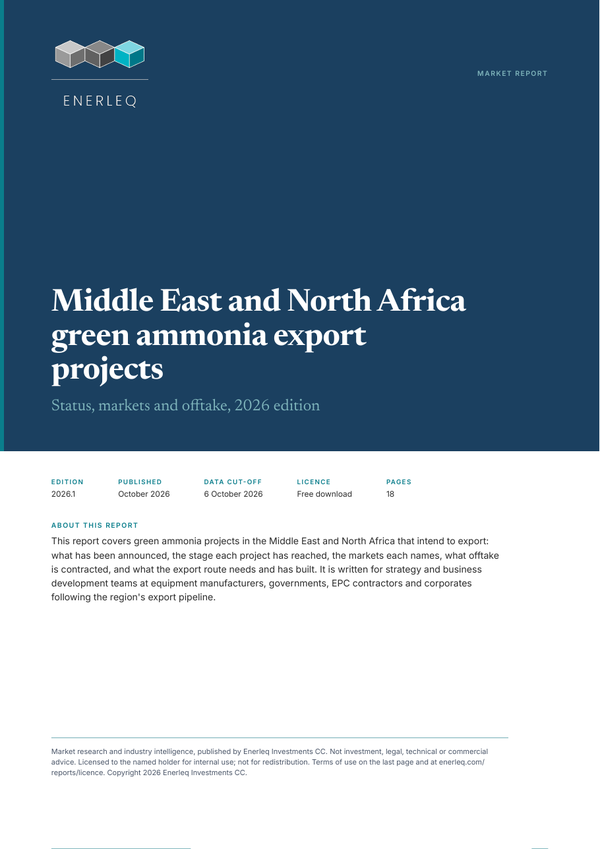
Middle East and North Africa green ammonia export projects
October 2026 · 18 pages · 33 projects
USD 395

Market report · 2026.1
Africa's green hydrogen, ammonia and methanol project pipeline
September 2026 · 26 pages · 56 projects
USD 995

Market report · 2026.1
Electrolyser supply in African and Middle East hydrogen projects
October 2026 · 22 pages · 28 projects
USD 395