Market report · Edition 2026.1 · Free
Electrolyser supply in African and Middle East hydrogen projects
Technologies and suppliers named, their scale and stage, 2026 edition
The register behind this report holds 18 hydrogen projects in Africa and the Middle East at FEED or later, with about 7.6 GW of stated electrolyser capacity. Sources name the electrolyser supplier for nine of them, and 12 of the 13 supplier links found rest on what a supplier or developer says.
About this report
This report covers the electrolysers in hydrogen projects in Africa and the Middle East: for each project at front-end engineering design (FEED) or later, whether a source names the electrolyser supplier and its technology, how many megawatts that supplier is stated to provide, and how far the supply arrangement has gone; which suppliers and technologies appear across the register; what manufacturing suppliers have announced in the two regions; and what has changed since 2024. It is written for strategy and business development teams at equipment manufacturers, project developers, EPC contractors, lenders and governments.
In scope
- Electrolytic hydrogen projects, and the ammonia, methanol, e-fuels and green iron projects built on them, in all 54 African countries and in the Middle East (Bahrain, Iran, Iraq, Israel, Jordan, Kuwait, Lebanon, Oman, Palestine, Qatar, Saudi Arabia, Syria, the United Arab Emirates and Yemen). Egypt and the other North African countries count as Africa
- The project set is every project at front-end engineering design (FEED), permitted, final investment decision (FID), construction or operating at the data cut-off, plus any project at any earlier stage for which a source names an electrolyser supplier or technology. Announced and feasibility-stage projects with no named supplier are not listed individually
- The electrolyser supplier: the company that supplies the electrolyser stacks or the packaged electrolyser system, as a source names it, with the stack technology as the source states it (alkaline, PEM, AEM, SOEC)
- The stage of each supply arrangement as sources report it: named, framework (MoU, heads of terms, preferred or framework agreement), selected, contracted (signed contract or purchase order), delivered, operating, ended
- Electrolyser factories, assembly lines, service hubs and joint ventures that suppliers have announced or built in the two regions, and the local-content terms that projects or governments cite for electrolysers
- Supplier links replaced, ended or lost since January 2024, and projects paused or withdrawn that carried a named supplier, with the reason as the source states it
Out of scope
- Electrolysers for chlor-alkali, water treatment or other non-hydrogen uses, and fossil hydrogen with carbon capture
- Balance-of-plant, power, EPC and compression suppliers, except where one is the stated electrolyser supplier
- Electrolyser prices, cost per kilowatt, efficiency, durability or any performance comparison between suppliers or technologies, except a figure a company states about its own product, worded as its statement
- Any ranking, scoring or rating of suppliers or technologies, any statement of market share, and any assessment of a supplier as better, safer or more suitable. A table that orders suppliers by a computed count (megawatts a source attributes to each, number of projects naming each) is analysis and is allowed
- Suppliers' financial results, orders outside the two regions, and any allegation about a company
- Project economics, offtake and export routes, which the Africa pipeline report and the Middle East and North Africa green ammonia report cover
Questions this report answers
- 01 Which African and Middle East hydrogen projects have reached FEED or later, at what stated electrolyser scale and stage, and how many of them have a source that names an electrolyser supplier or stack technology?
- 02 Which electrolyser suppliers and which stack technologies are named across announced projects in the two regions at any stage, for how many projects, and for how many megawatts does a source attribute to each?
- 03 For the projects at construction, FID or operating, how far has each supply arrangement gone (named, framework, selected, contracted, delivered, operating), and which of those links does a stock-exchange disclosure, lender document or government source confirm rather than only a company release?
- 04 Which electrolyser factories, assembly lines, service hubs and joint ventures have suppliers announced or built in Africa and the Middle East, and which local-content terms do projects or governments cite for electrolysers?
- 05 Which supplier links have been replaced, ended or lost since January 2024, and which projects that carried a named supplier have been paused or withdrawn, with the reasons the sources give?
Written for strategy and business development teams at equipment manufacturers, project developers, EPC contractors, lenders and governments.
Contents
-
Executive summary
-
1. The projects: scale and stage
- What the register holds
- Operating and under construction
- At FEED
- Where the stage is not established
- Changes from Enerleq's earlier registers
-
2. Suppliers and technologies named
- The suppliers
- The technologies
- What the sweep did not find
-
3. How far the supply arrangements have gone
- The arrangements
- Who confirms them
- How much capacity has a supplier
-
4. Manufacturing in the two regions, and what has changed
- Factories and local content
- What has changed since 2024
-
Appendix A. Supplier and project register
- Methodology and sources · Disclaimer and licence
Exhibits
- Exhibit 1 Electrolyser capacity by project stage, October 2026
- Exhibit 2 Megawatts a source attributes to each named supplier, all stages
- Exhibit 3 Megawatts by stack technology as sources state it, all stages
- Exhibit 4 Supply arrangement for each project at FEED or later, and for those whose stage is not established
- Exhibit 5 Electrolyser capacity at FEED or later by the furthest supply arrangement reached
- Exhibit 6 Appendix A1. Project register, October 2026
- Exhibit 7 Appendix A2. Supplier links, October 2026
Sources
63
sources cited, each listed in the report with its publisher, link and retrieval date
- Tier 1 · Primary
- 14
- Tier 2 · Official and reputable
- 24
- Tier 3 · Company statements
- 25
How this report was made
- Scope
- Electrolytic hydrogen projects, and the ammonia, methanol, e-fuel and green iron projects built on them, in Africa and the Middle East. The register is non-exhaustive: it holds the projects at FEED, FID, construction or operating at the data cut-off that the searches found in the countries searched, any project found for which a source names an electrolyser supplier, and projects the earlier Enerleq registers held at those stages that no tier 1 or 2 source read places at FEED or later; these are shown as "not established". The register grades no stage below FEED; Enerleq's ammonia and Africa pipeline reports record such projects as feasibility or announced. A project counts at FEED when a tier 1 or 2 source states that FEED work has started or that a FEED contract has been awarded. The electrolyser supplier is the company that supplies the stacks or the packaged system, as a source names it. Balance-of-plant, power and EPC suppliers, prices, performance and market shares are out of scope.
- Approach
- The register in Appendix A was built project by project from developer, supplier and lender disclosures, government and allocation-body statements, H2Global, PtX Hub and IEA-based tabulations, and named-reporter trade press, to the data cut-off. Countries searched for projects at FEED or later: Saudi Arabia, Oman, the United Arab Emirates, Jordan, Qatar, Bahrain, Kuwait, Iraq, Israel and Iran in the Middle East (nothing at FEED or later was found in the last six), and Egypt, Morocco, Mauritania, Namibia, South Africa and Kenya in Africa. Tunisia, Algeria, Senegal, Angola, the other African countries, Lebanon, Syria, Yemen and Palestine were not searched, so the project set is not exhaustive. Suppliers were searched one by one; a supplier with no link in this report is "not found", not "no link". Searches for changes since 2024 were in English only. A link resting only on a tier 4 source, a paywalled headline or a search snippet is not recorded. Where sources disagree, the report states both. The Walvis Bay site, which two sources may describe as two projects, is counted once. Helios Industry's KIZAD project is listed although below FEED, by the principal's decision. Every fact sentence carries a citation to the numbered list; sentences that draw a conclusion from cited facts in the same paragraph are not separately cited.
- Conventions
- Electrolyser capacity is input capacity in MW as published, and is left blank where a developer publishes only tonnes or renewable power. Supplier megawatts are those a source attributes to that supplier for that project; a project's full capacity is never assumed to come from one supplier. Supply arrangements are recorded at the highest status a source states: named, framework (memorandum, cooperation or framework agreement), selected, contracted (supply contract, agreement or order), delivered (shipped or installed), operating, ended. Technology is as the source states it: alkaline, PEM (proton exchange membrane), AEM (anion exchange membrane), SOEC (solid oxide), E-TAC (H2Pro's electrochemical, thermally activated chemical process). Projects under 10 MW are pilots. Stage terms are: FEED, FID, construction, operating, paused, not established (not at FEED or later on the sources read).
- Interviews
- None were conducted for this edition.
What is original
The supplier and project register in Appendix A and the 7 exhibits are compiled by Enerleq, row by row, from the cited sources. No table or chart is reproduced from another publication.
How it was checked
Every cited sentence and table row was checked against its source, corrections were applied, and later changes were re-checked before the principal approved this edition for release on 12 October 2026.
Use of AI
Enerleq uses AI tools to collect and organise sources and to prepare first drafts. Every factual statement is tied to a cited source, every draft is reviewed and edited by the principal, and commentary marked ENERLEQ VIEW is the principal's own.
Licence
A free report is licensed to the person who requests it, for personal reference and internal use within that person’s organisation, and may be quoted with attribution. It may not be sold, republished or redistributed.
Market research and industry intelligence, not investment, legal, technical or commercial advice. Full terms: Report Licence.
Questions about this report
About its scope, sources or method, or to report an error.
Dr Sakib Khan
Founder & Principal, Enerleq
Related reports
Reports that share a topic or a region with this one.
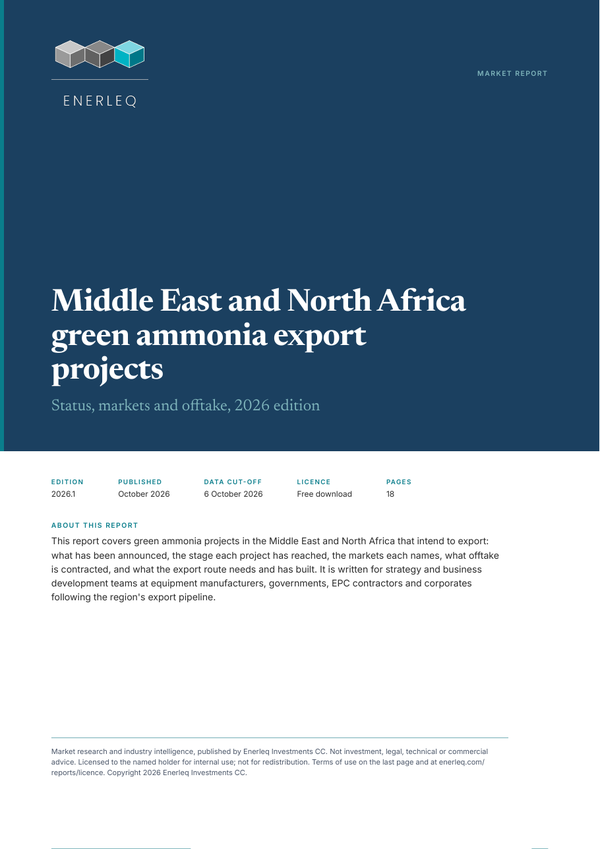
Market report · 2026.1
Middle East and North Africa green ammonia export projects
October 2026 · 18 pages · 33 projects
Free
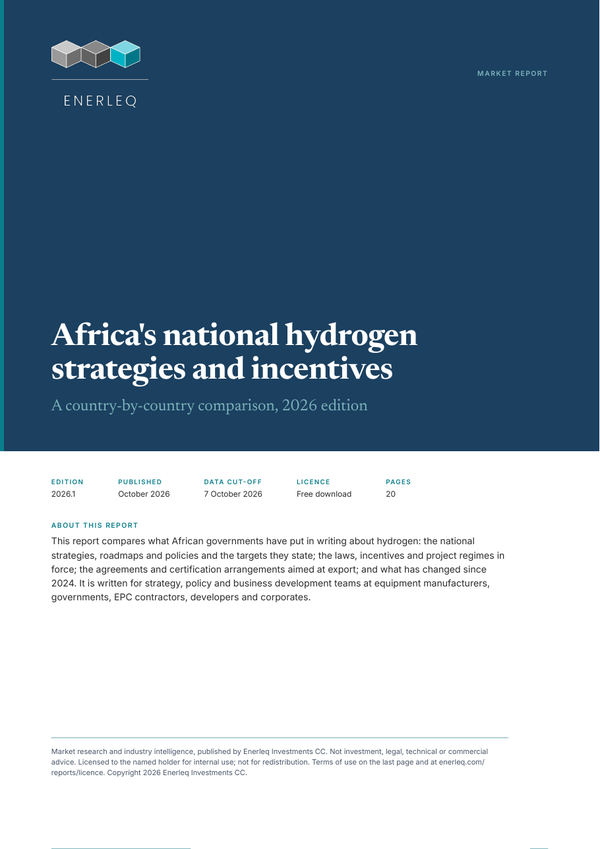
Market report · 2026.1
Africa's national hydrogen strategies and incentives
October 2026 · 20 pages
Free

Market report · 2026.1
Africa's green hydrogen, ammonia and methanol project pipeline
September 2026 · 26 pages · 56 projects
USD 495